Event
Fall of Akkad to the Guti Arabs; start of the "Arab" dynasty of Babylon
CFAH AP-35 and AP-42: Akkad (Babylon) fell to the Guti and Arabs in 1477/1476 BC, beginning the "Arab" Dynasty 5 (1477–1232 BC).
Tier 1: CFAH anchor point: 1477/1476 BC (AP-35)
Description
CFAH-5 identifies Berossus' "Arabian" conquest of Babylon with the Fall of Akkad to the Guti and Amorites, and the end of the Arab dynasty (1232 BC) with Tukulti-Ninurta I, whom it suggests was remembered as Semiramis II (AP-15). CFAH-5 Conclusions call this one of its two "most controversial findings".
Chronologies
| Chronology | Date as stated | Year (BC / AM) | Citation & note |
|---|---|---|---|
| CFAH anchor point | 1477/1476 BC Precision: year-range |
1477/1476 BC | Griffith & White, "Chronological Framework of Ancient History. 5: The Babylonian Dynasties of Berossus," ARJ 16 (2023): 635–670, section "AP-35: Fall of Akkad to the Guti Arabs: 1477/1476 B.C."; also "AP-42: Dynasty 5: “Arab” Dynasty: 1477–1232 B.C." (opens in a new tab) CFAH-5: "The date 1477 B.C. will prove to be pivotal when we synchronize the Arab dynasty of Babylon with the Arab/Hyksos dynasties of Egypt in the next paper." Sets sort year |
| Ussher-Jones | Not yet established | — | — Jones (Chart No. 1; Chronology of the Old Testament, 2002) gives no date for this extra-biblical event. |
| Ussher | 2466 AM, 1538 BC Precision: year |
1538 BC AM 2466 |
Ussher, Annals of the World, Third Age §167 (paragraph numbering of the modern transcription) (opens in a new tab) "In this war the Chaldeans were defeated and the Arabians reigned in the country of Babylon 216 years before Belus the Assyrian came there to reign." Ussher dates this to 1538 BC; CFAH quotes the same passage (as Ussher 2003 §164,165) but dates it 1477 BC. Difference: 61 years. Differs from sort year by 61 yrs |
Disagreements & open questions
- Chronologies disagree BC years differ: 1538 BC (Ussher); 1477 BC (CFAH).
Flags are generated from the figures stored in the data. The master timeline still sorts by the CFAH-weighted sort year.
Related
CFAH charts
-
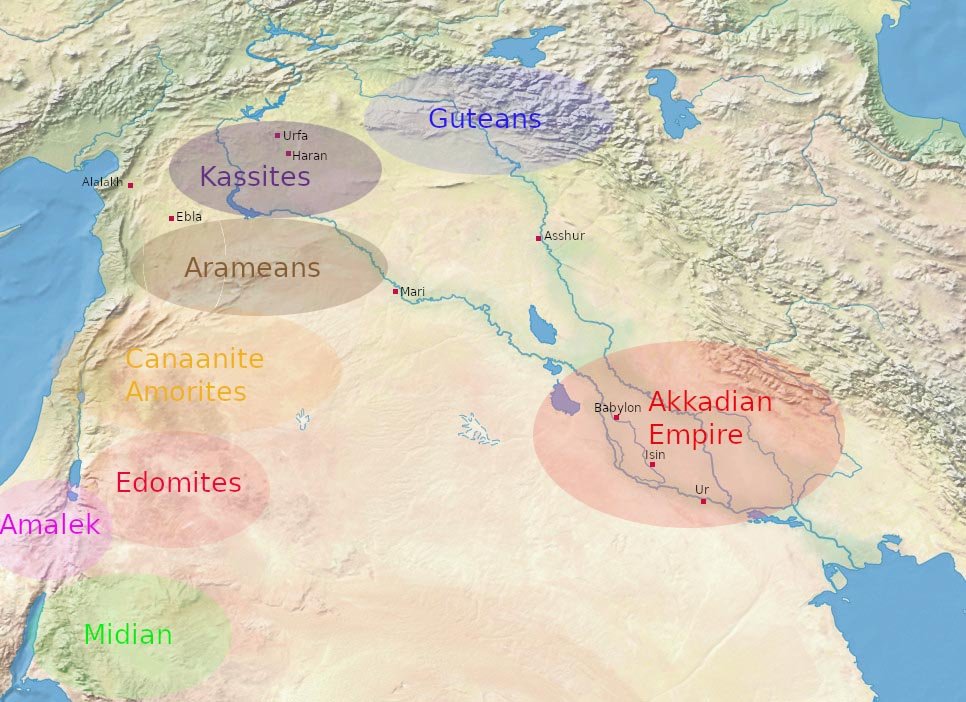 (full image opens in a new tab)
CFAH-5 · Fig. 3
Territories of Amorites and Arameans prior to the fall of Akkad.
AP-42: Dynasty 5: “Arab” Dynasty: 1477–1232 B.C.
Image credit (per the paper): Fulvio314, “Middle East topographic map-blank,” https://en.m.wikipedia.org/wiki/File:Middle_East_topographic_map-blank_3000bc_crop.svg. CC BY 3.0.
Records: Fall of Akkad to the Guti Arabs; start of the "Arab" dynasty of Babylon
Answers Research Journal (publicly served image; hotlinked, not copied)
-
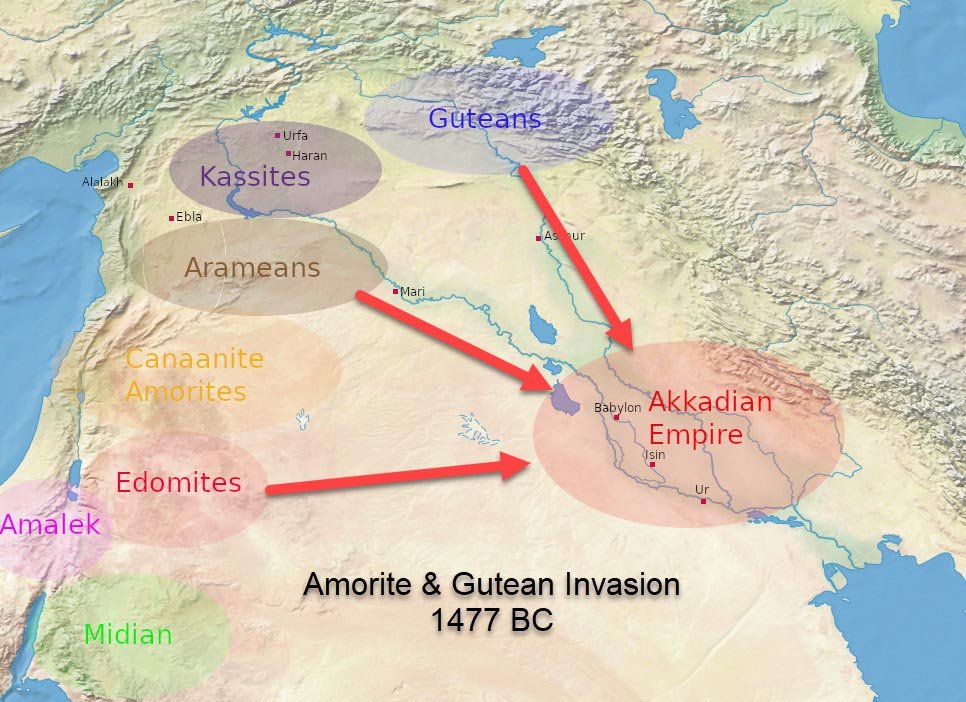 (full image opens in a new tab)
CFAH-5 · Fig. 4
Amorite invasion in 1477 B.C.
AP-35: Fall of Akkad to the Guti Arabs: 1477/1476 B.C.
Image credit (per the paper): Fulvio314, “Middle East topographic map-blank,” https://en.m.wikipedia.org/wiki/File:Middle_East_topographic_map-blank_3000bc_crop.svg. CC BY 3.0.
Records: Fall of Akkad to the Guti Arabs; start of the "Arab" dynasty of Babylon
Answers Research Journal (publicly served image; hotlinked, not copied)
-
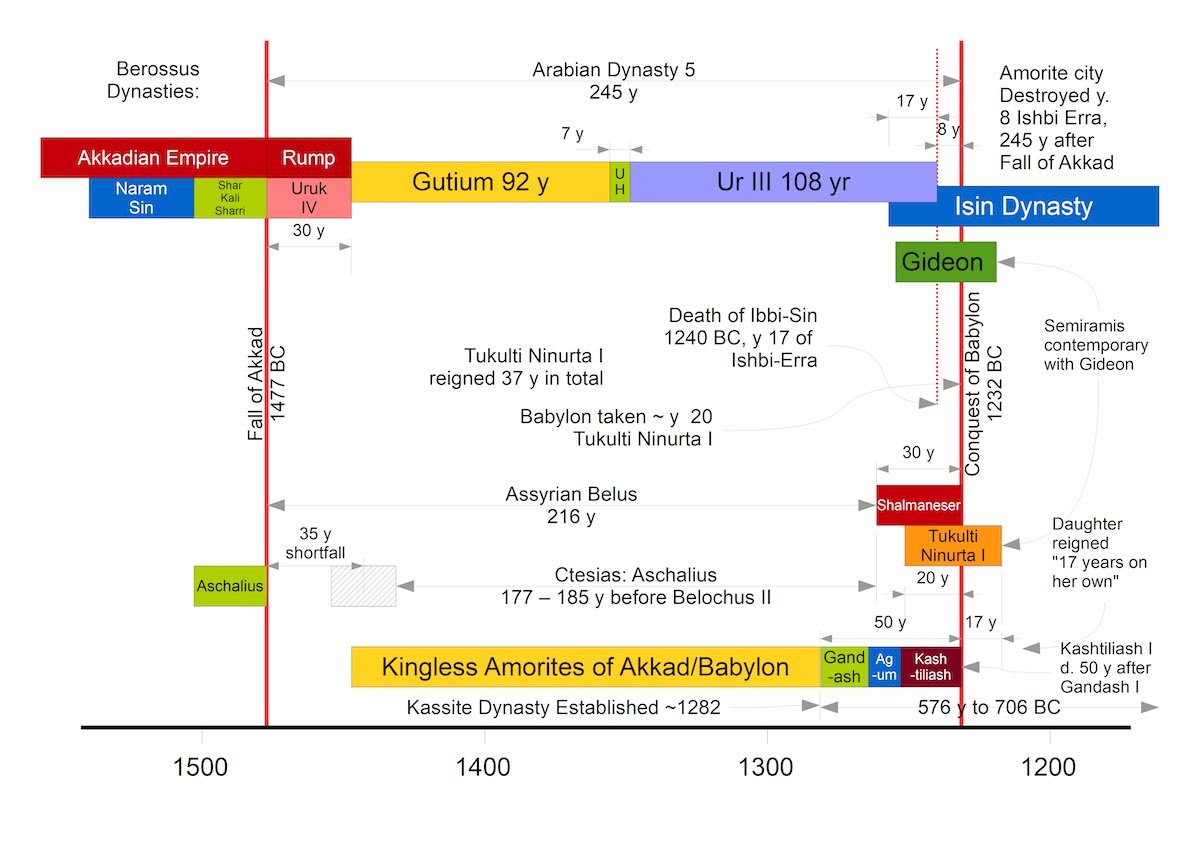 (full image opens in a new tab)
CFAH-5 · Fig. 6
Addition durations to the Fall of Akkad.
Confirmation of the Fall of Akkad Via Other Sources
Records: Fall of Akkad to the Guti Arabs; start of the "Arab" dynasty of Babylon
Answers Research Journal (publicly served image; hotlinked, not copied)
Free sources
- Chronological Framework of Ancient History. 5: The Babylonian Dynasties of Berossus, (opens in a new tab) — section "AP-35: Fall of Akkad to the Guti Arabs: 1477/1476 B.C."; also "AP-42: Dynasty 5: “Arab” Dynasty: 1477–1232 B.C." free-to-read
- The King James Version of the Bible (opens in a new tab) public-domain
- The Annals of the World, Deduced from the Origin of Time (1658 English edition), Part One: 4004–176 BC (opens in a new tab) public-domain
Copyrighted works (CFAH papers, F. N. Jones) are linked, not reproduced.